
Reviewed · FULL-DAY
Beirut Full Day Walking Tour
Beirut can feel like one long maze, with street names that do not behave and whole blocks that change personality overnight. This full-day walking tour is interesting because it turns that chaos into a clear east-to-west route, from Roman-era leftovers to the scars of the civil war and the city today.
I really like the small group pace (max 15), because it means you can ask questions without feeling rushed. I also love that the guide, often Georges, connects each stop to a bigger story, with stops ranging from Martyr’s Square to the Mohammad al-Amin Mosque and the Green Line. The one drawback to plan around is the physical side, you need strong walking fitness for about 6 hours.
You’ll also appreciate the simple, practical “fuel plan.” The tour includes a lunch based on lahmadjun or falafel plus coffee and beer, so you are not stuck hunting for food mid-walk. One more consideration: there is no gluten-free street food option listed, so you’ll want to plan accordingly if gluten is an issue.
Key highlights worth your attention
- East-to-west orientation with a real local guide, not a map and a guess
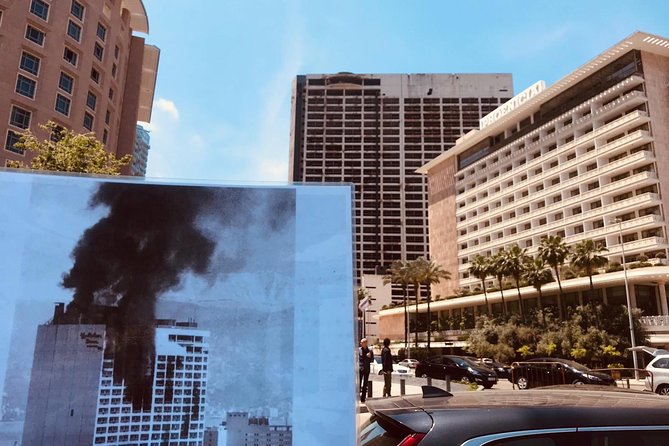
- Civil war explained on the ground, including the Green Line and the Holiday Inn hotel battles
- Roman Baths in the middle of modern Beirut, plus Ottoman-era traces nearby
- Food included, not optional, with lahmadjun (vegetarian option) and coffee plus beer
- A route that mixes famous monuments with quieter neighborhoods, including Zokak el-Blat and the antique lanes
Why walking Beirut beats trying to DIY the center
If you try Beirut on your own, you can end up doing a lot of circling and still miss the meaning of what you are looking at. The tour is designed for the way the city actually works, with layers that sit on top of each other, and street-level details that matter if you know what to notice.
The walking format is also the point. You get to see how Roman and Ottoman elements survive beside redevelopment projects, and how religious sites sit near political landmarks. With a group size capped at 15 people, the guide can keep the pace human and handle the constant little “wait, look at this” moments.
And yes, the guide matters. Georges is often described as a geophysicist with archaeology background, which shows in the way he talks about what is under your feet, what was built for power, and what was rebuilt after destruction. That angle makes the whole day feel less like sightseeing and more like Beirut in motion.
Other days out of Beirut to consider
- PRIVATE Beirut Historical Walking Half Day Tour
★ 5.0 · 27 reviews - Beirut: Private Walking Tour With A Guide (Private tour)
★ 4.9 · 9 reviews
Price and timing: what $41.03 buys you
At $41.03 per person for around 6 hours starting at 9:30 am, the value comes from what is included. This is not a “just walk and good luck” deal.
Here is what you actually get:
- Guiding for the whole route (plus all fees and taxes)
- A simple included lunch, plus coffee and beer
- Multiple major stops where the tour notes indicate no separate admission requirements
- A mobile ticket
- The itinerary ends back at the same meeting point in Martyr’s Square
What you should keep in mind is what is not included. There’s no private transportation, so you are committing to getting around on foot for most of the day. If you plan your footwear and your expectations (steady walking, some uneven streets), the price feels fair for the amount of ground covered and the interpretation you get along the way.
A quick weather note: this experience requires good weather. If it is canceled because of poor weather, you’ll be offered another date or a full refund. Otherwise, the experience is listed as non-refundable and cannot be changed.
Martyr’s Square to Place de l’Etoile: where Beirut maps power
The day starts at Martyr’s Square, one of those places where monuments are political even when they look like simple stone. You’ll spend time at the statue and the remains of the Petit Serail, plus nearby landmarks like the Ciné Opéra. This is where the tour sets the tone: Beirut is not just scenery, it is memory.
From there, you move to Samir Kassir square and statue. The guide’s job here is to connect the civil war story to more recent events, including the post-2005 assassinations. Even if you know only a little, the way it is framed helps you understand why Beirut still feels like it is negotiating its past in public.
Next comes Place de l’Etoile. This stop is especially useful because it links big ideas to urban design. You’ll hear about the Lebanese political system, and how Ottoman and French urban planning influenced what you see. You also get to spot the Al Abed Clock tower and the parliament area, which turns the skyline into a political diagram.
You then take a short break at the Greek Orthodox Cathedral of Saint George. It is brief, but it matters because it adds another layer of religious geography to the political one you just learned.
Practical tip: this first stretch is dense with meaning and names. If your attention span fades, take a breath at each landmark and let the guide “land” the main point before you move on.
Garden of Forgiveness, Roman Baths, and the souks beneath modern Beirut
After the political and religious landmarks, the tour shifts toward physical history. The Garden of Forgiveness archaeological area is quick, about 5 minutes, but it is strategically placed. You’ll see the archaeological site, and the tour also points out viewpoints where you can see the Mohammad Al-Amin Mosque and the Maronite Saint Georges Cathedral.
This matters because it shows how Beirut’s major buildings are not isolated islands. They are part of an urban puzzle, connected by sight lines, proximity, and the way the city expanded and re-expanded.
Then you hit the Roman Baths. For about 10 minutes, you’ll get a look at the bath area and learn about nearby references like the Le Grand Serail and an Ottoman military hospital. This is one of those spots where the city’s timeline becomes visible, you stop looking at a ruin and start seeing how later rulers reused the same geography.
Next up: Beirut Souks. You’ll pass through major commercial landmarks, including the L’Orient building and the Zaha Hadid building. Even if you do not shop, the souks section gives you the feel of Beirut as a working trade hub, not a museum city.
Finally, you reach Zaytouna Bay and the Yacht Club of Beirut. It is a change of mood, water, reflections, and a different style of “Beirut now.” It’s a useful reset between the heavier historical stops.
A different spoke from Beirut:
- Guided Small-Group Tour to Baalbek, Anjar and Ksara with Lunch
★ 5.0 · 511 reviews - Guided Small-Group Tour to Jeita, Harissa, Byblos with Lunch
★ 5.0 · 361 reviews - Paragliding Trip Over Lebanon – Jounieh Bay
★ 5.0 · 257 reviews - Jeita Grotto,Harissa&Byblos Full-Day PRIVATE-CAR Trip from Beirut
★ 5.0 · 222 reviews
Holiday Inn and SOLIDERE battles: seeing the civil war in architecture
One of the hardest parts of Beirut history is that you often cannot see the war itself, only what it left behind. This tour makes that connection directly with architecture and street landmarks.
You start with the Saint George’s Maronite Cathedral section and the tour’s focus on the Saint Georges/SOLIDERE real estate battle. This is not just a name drop. The guide uses the cathedral area to explain how redevelopment can become political, and how different communities see the same space in different ways.
Then comes the Holiday Inn hotel stop. This is a standout for many people because it is so specific. You’ll hear about the civil war at the Qantari front, and the battle of the hotels in 1975. It is one thing to hear that Beirut had conflict, it is another to see it tied to a recognizable urban landmark.
For me, this is where a walking guide earns their pay. You are not reading a timeline, you are looking at the city and being shown where the story sits.
Zokak el-Blat plus lahmadjun lunch: the day gets human
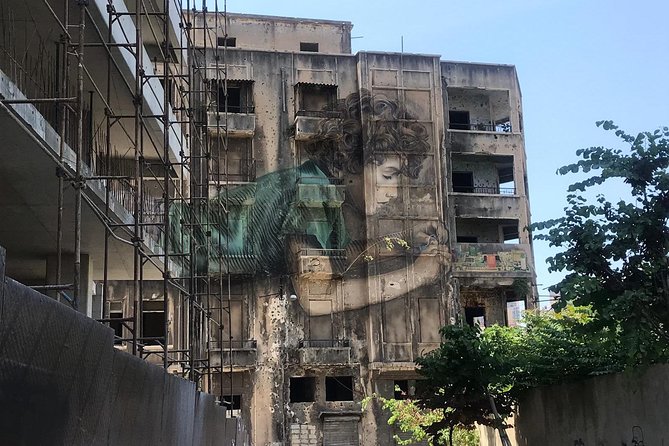
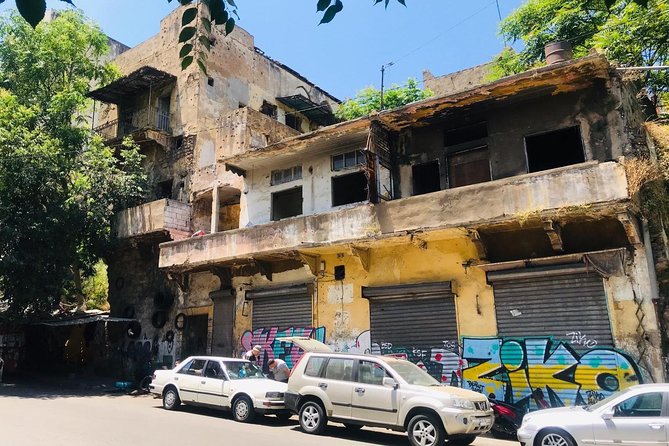
The tour slows down for food and for a neighborhood that many first-time visitors skip. You’ll enter the Zekak Al Blat district, starting with the Zokak El Blat Public School. The guide talks about 19th century Beirut, and the whole point of the stop is atmosphere.
This is also where you grab lunch. The included lunch is one lahmadjun from Ishkhanian Bakery or falafel sandwiches, plus coffee and beer. The lahmadjun option includes a vegetarian alternative, which is great if you eat meatless. The big warning is gluten: there is no street food option for gluten-intolerant travelers, so this is not the tour to count on for a gluten-friendly meal.
Even with that limitation, lunch is a real advantage. It is built into the route, so you avoid the trap of “I’ll eat later” in a city where later can mean another long detour.
After lunch, you move to the Beirut Antique District. You’ll walk via areas of antique shops, and note that they will be closed. That is normal, it helps to come ready for the fact that some spaces are quiet outside their opening hours. You continue toward Khadak El Ghamik street, keeping the walk varied instead of looping through the same central streets.
Reaching the Green Line via the BDD, then the Egg bunker
Now the tour gets more intense. You will pass by the BDD to reach the Green Line, described as the separation line between Christians and Muslims during the civil war. It is one of the clearest examples of how the city’s divisions were not abstract. They were visible, walked, and enforced.
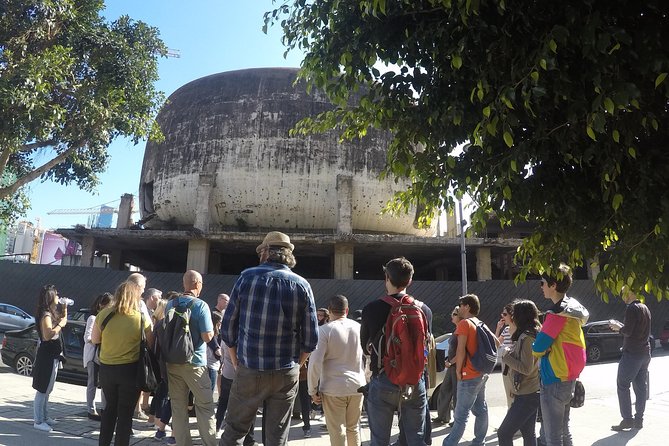
Next is the Egg, the former Metropole Cinema. You will stop outside and learn about how it was transformed into a bunker during the civil war. The tour notes that you will not go inside, but the stop is still valuable because you see a former public space turned into something defensive.
This is also where the storytelling can feel like a guided walkthrough of the city’s shifting phases. The tour plans a 20-minute stop here, so you are not left with a quick photo and a vague explanation.
If you want the day to make emotional sense, this is the moment. Roman Baths are one kind of time travel. The Egg and the Green Line are another kind, where the timeline is trauma and rebuilding.
Mohammad Al-Amin Mosque and the final stretch through Saifi to Gemmayzeh
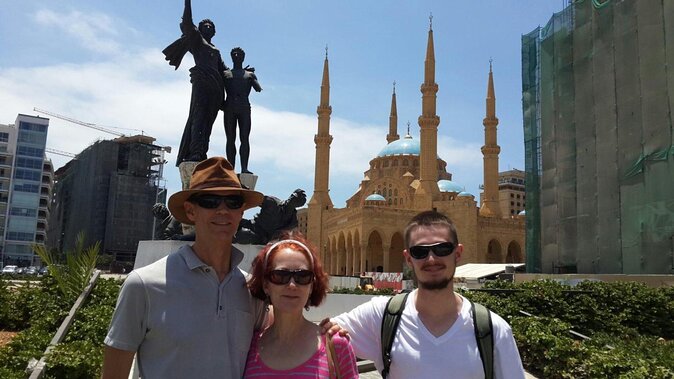
After the Green Line and the Egg, you end this part of the story at the Mohammad Al-Amin Mosque. You’ll visit the largest mosque of Beirut and hear discussion tied to the assassination of former prime minister Rafic Hariri. Again, it is about connecting the physical landmark to the living political narrative.
From there, you head into Saifi Village. You’ll pass by and talk about SOLIDERE and architectural styles in Beirut. This stop works well if you like seeing how new designs and old urban logic coexist, sometimes peacefully, sometimes not.
Then you make a brief stop at the Nicolas Sursock Museum. You won’t spend long here, but you’ll hear about the old statue of the Martyrs and the Sursock Family. It’s a short cultural punctuation mark before the final streets.
To wrap up, you head to Gemmayzeh Street and walk back along Gouraud street to Martyr’s Square. This closing section matters because it ties the day together. You start at Martyr’s Square with monuments and then finish with the day’s walking rhythm and neighborhood feel, ending back at the meeting point.
Who this Beirut walk is perfect for, and who might want something else
This tour fits best if you want a structured way to understand Beirut’s contradictions: Roman remnants, Ottoman and French planning, major religious landmarks, the civil war’s physical traces, and redevelopment projects all in one day.
You will probably love it if:
- You enjoy history, especially the civil war story told through real street landmarks
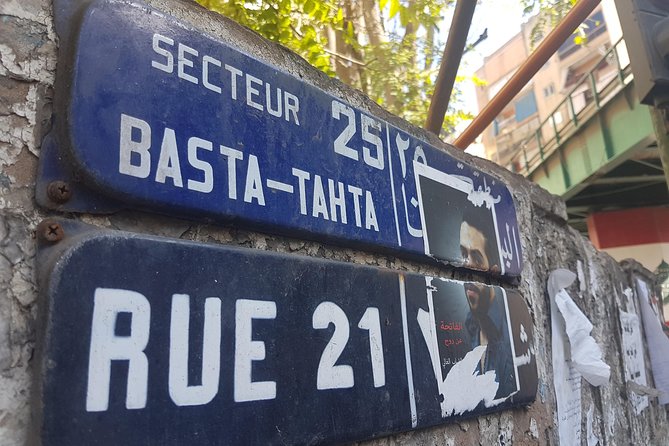
- You want a guide to decode signage, street naming confusion, and the “why is this here” questions
- You want a practical included meal instead of spending your time looking for food
You might want to choose something different if:
- You cannot walk for about 6 hours and keep pace on a street-level route
- Gluten-free food is essential for you, since no gluten-intolerant street food option is listed
- You are seeking a purely relaxed sightseeing day with minimal political context
Also note: the tour is listed as near public transportation, but it is still a walking-first experience.
Should you book this Beirut Full Day Walking Tour?
If you like cities with complicated layers, this is an excellent way to get oriented fast. The price feels reasonable because you are not just paying for a walk. You are paying for a guide-led route, lots of major stops across the city, and an included meal with coffee and beer.
My main reason to book is the structure. The tour goes east to west, keeps the day moving, and gives you a narrative so Beirut stops feeling like random contradictions and starts feeling like a readable place.
My main reason to hesitate is practical: you need strong physical fitness and you need to plan for gluten limits. If that fits you, book it and wear shoes you trust.
Newest Beirut write-ups
- Small Group Tours to Jeita Grotto and Byblos with tickets★ 5.0 · 3 reviews
- Small-Group Tour with Lunch to Jeita Grotto, Byblos and Harissa★ 4.5 · 3 reviews
- Small-Group Tour with Lunch to Baalbek, Anjar and Ksara★ 5.0 · 3 reviews
- Small-Group Tour to Sidon, Tyre and Maghdouche with Lunch and Tickets★ 4.5 · 3 reviews
- Beirut to Qadisha Valley, Bcharri & Cedar: Daily Tours with Lunch★ 4.5 · 3 reviews
- Beirut to Sidon, Tyre and Maghdouché: Daily Tours with Lunch★ 5.0 · 3 reviews
- Exploring Beirut’s Past: A Private Guided Historical Tour★ 5.0 · 3 reviews
- Private Tour: Tyre, Sidon and Maghdouche Day Trip from Beirut★ 4.5 · 3 reviews
Full-Day, compared.
Jeita Grotto,Harissa&Byblos Full-Day PRIVATE-CAR Trip from Beirut
Read our review →
Guided Private Full Day Tour to Baalbek, Anjar and Chateau Ksara
Read our review →
Jeita Grotto, Byblos and Harissa Full-Day Tour from Beirut
Read our review →
Full-Day Private Tour to Jeita Grotto, Harissa and Byblos
Read our review →
Guided Full-Day Private Trip to Cedars, Baalbek and Chateau Ksara
Read our review →
Full-Day Guided Tour of Northern Lebanon with Hotel Pickup
Read our review →
Full-Day Private Trip to Jeita Grotto, Baalbek and Chateau Ksara
Read our review →
Full day Tripoli private great guide/all-in + rustic meal
Read our review →Browse the lists this tour appears in